


In the fast-evolving landscape of sports betting, the pursuit of consistent profitability hinges on the ability to identify value bets—opportunities where the odds reflect a higher return than the true probability of an event occurring. Understanding this delicate imbalance is crucial for bettors aiming to transform their sports passion into a disciplined, strategic venture. The art lies in combining rigorous odds analysis, probability assessment, and market inefficiencies to detect these hidden edges, converting them into sustainable winnings. Value betting is not about luck; it’s a mathematical approach grounded in expected value and risk management, demanding patience and an analytical mindset.
Mastering this skillset opens doors to a world beyond casual wagers. It enables you to spot when the market has mispriced an outcome due to popular bias, slow line movement, or underappreciated factors. Whether it’s an injury scenario that hasn’t been factored into odds or a niche market overlooked by most bettors, identifying valid discrepancies can tilt the odds in your favor over time. This nuanced guide dives headfirst into the fundamentals and complexities behind value bets, detailing how to calculate expected value, apply probability effectively, and implement strong betting strategies that emphasize disciplined record-keeping and continuous calibration of your models.
- Value bets represent wagers where the true probability exceeds the implied odds, creating a positive expected value (+EV).
- Calculating expected value using solid odds analysis and independent probability assessment is the backbone of all successful betting strategies.
- Identifying market inefficiencies such as public bias, injury underestimation, and delays in line adjustments makes spotting value bets possible.
- Effective use of tracking tools and detailed records enhances long-term risk management—key to converting short-term variance into consistent profits.
- Successful value betting requires patience, discipline, and a commitment to ongoing learning and model refinement.
Understanding the Core Principle of Value Bets through Expected Value
At the heart of profitable sports betting lies the concept of expected value (EV), a mathematical expectation that quantifies the average return you can anticipate from a wager over many repetitions. Unlike impulsive or gut-driven bets, value betting is rooted in a systematic comparison between your assessment of an event’s probability and the implied probability derived from the sportsbook’s odds.
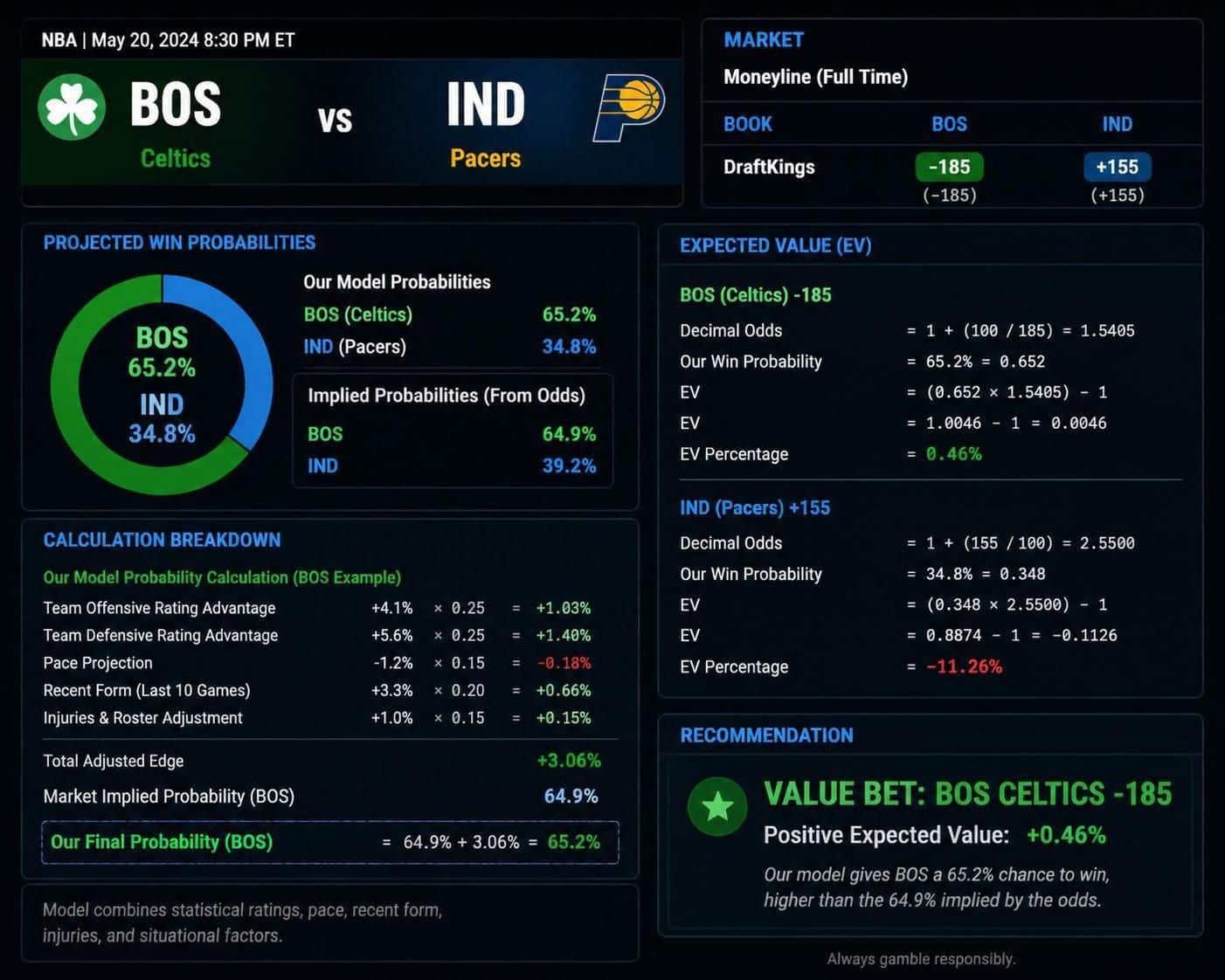
Expected value is calculated as follows: EV = (Probability of Winning × Profit if Win) – (Probability of Losing × Loss if Lose). This formula provides a clear metric for evaluating the profitability of any given bet. For example, imagine placing a $100 wager on a team with +150 odds (which translates to decimal odds of 2.50). If your own analysis concludes that the team has a 45% chance of winning, the expected value calculation would be:
| Component | Value |
|---|---|
| Probability of Winning | 0.45 |
| Profit if Win | $150 |
| Probability of Losing | 0.55 |
| Loss if Lose | $100 |
| Expected Value | $12.50 (Positive) |
The positive outcome here (+$12.50) signals that this wager has a favorable expected return over the long run, even though individual bets may often lose. This crucial distinction makes patience and proper risk management essential. Over time, the law of large numbers ensures that +EV bets yield profitable results, which is why analyzing bets at this foundational level is paramount.
Understanding how to convert betting odds into implied probabilities is also fundamental. For instance, odds of +140 imply about a 41.7% chance of the outcome occurring (using the formula: implied probability = 100 / (odds + 100) for American odds). By comparing such implied probabilities with your independently calculated estimates, you can locate discrepancies where the market has potentially undervalued an outcome — creating value.
For those interested in delving deeper into the mechanics, comprehensive tools and calculators are available which can simplify these computations while enhancing your ability to identify profitable wagers. Exploring reliable value betting guides can provide further insights and practical examples to sharpen your strategy.
Leveraging Market Inefficiencies and Public Bias to Uncover Value Bets
The inherent imperfections in betting markets are the very source of value bets. Sportsbooks operate with sophisticated algorithms, but they cater to wide audiences shaped by popular sentiments and betting volumes. This dynamic creates opportunities for the savvy bettor who can detect subtle discrepancies ignored by the majority.
One common inefficiency arises from public bias. Popular teams, marquee events, and primetime games often see odds favorable to bettors wagering on these favorites. However, such inflated public perception causes the odds on underdogs and less spotlighted outcomes to provide richer value. Recognizing this pattern is a starting point for uncovering favorable bets, especially in markets where emotional bias skews the pricing.
Other inefficiencies stem from the sportsbook’s response lag. Injury news or lineup changes frequently impact an event’s true probability but may take time to reflect in updated odds. For example, a key role player’s injury might be downplayed by the market, offering an edge for those who have timely and accurate information. Niche markets like international soccer leagues or lesser-followed college sports often have less efficient lines due to limited betting volume, presenting prime hunting grounds for value bettors.
Furthermore, brooming lines across various platforms do not happen simultaneously. Some sportsbooks update their odds quicker than others, offering brief windows for arbitrage or value exploitation. The sharp bettor capitalizes on these timing differences, making swift moves can translate perceived inefficiencies into real profits before the market corrects itself.
To illustrate, consider a basketball game where the public is heavily backing the favorite team, driving the odds down to an undervalued point for the underdog. Your probability assessment suggests the underdog actually has a 48% likelihood to win when odds imply only about 41.7%. Placing a bet on the underdog in this scenario incorporates an inherent value. Such insights are vital to refining strategies in real-time sports wagering.
For a comprehensive understanding of detecting and exploiting these market inefficiencies, specialized resources are invaluable. For instance, the guide on how to find value bets walks through practical steps that strengthen your betting acumen.
Formulating Your Own Probability Assessment and Odds Analysis Methods
Central to effective value betting is the ability to independently calculate the probability of outcomes rather than relying solely on public or sportsbook projections. Developing a robust model requires integrating diverse data sources: historical performance metrics, player form, situational statistics, weather conditions, and head-to-head records among others. This holistic approach transforms mere guesswork into a disciplined exercise in data-driven analysis.
A critical skill is converting these probabilities into actionable insights. After estimating the likelihood of an outcome, you must translate bookmaker odds back into implied probabilities to compare with your model. This comparison reveals where the market is either overly conservative or aggressive.
Research is ongoing and complex. For example, different sports have varying levels of market efficiency. NFL spreads are typically very efficient due to heavy betting volume and sophisticated market scrutiny, while international soccer leagues or individual player prop bets often exhibit more price inefficiencies, thus more frequent value betting opportunities.
To systematically improve your edge, implement these steps:
- Gather comprehensive data: Use statistics, analytical reports, and expert commentary about the sport and teams involved.
- Build predictive models: Utilize regression analysis, machine learning algorithms, or simpler rating systems to estimate probabilities.
- Assess odds as implied probabilities: Convert offered odds into their implied probability counterparts using standard formulas.
- Compare your model’s probability with the market’s implied probability: Identify mismatches where your probability exceeds the implied number, signaling potential value bets.
- Document rationale: Note key reasons why your model might differ from public or sportsbook perception, such as injury updates or tactical mismatches.
Consistency and continuous refinement through feedback loops help align your probability assessments closer to reality over time. This persistence in odds analysis leads to better calibration and improved betting performance.
Implementing Discipline with Tracking and Risk Management to Maximize Long-Term Profitability
A hallmark of professional value bettors is rigorous record-keeping and risk management. Tracking enables you to analyze your betting decisions, validate your models, and improve accuracy while quantifying your long-term expected value performance. Without this discipline, it’s easy to fall prey to overconfidence or misjudgment.
Create a detailed log for each wager that captures:
- The estimated probability you assigned for the outcome.
- The implied probability based on the odds you accepted.
- The calculated expected value of the wager.
- The stake amount and actual result of the bet.
- Contextual notes explaining why you identified that bet as having value.
Such a system empowers periodic reviews to measure if your probabilistic predictions match actual outcomes. If bets tagged at a 55% probability are only winning 48% of the time, it signals the need to recalibrate your forecasts.
Risk management is equally critical to protect your bankroll through controlled bet sizing and avoiding emotional decisions. Since even positive expected value bets experience variance, maintaining a level-headed strategy helps withstand losing streaks and capitalize on profitable runs.
The following table outlines a sample tracking format for clarity on managing your betting portfolio:
| Bet Date | Event | Estimated Probability | Implied Probability | Expected Value | Stake | Result | Notes |
|---|---|---|---|---|---|---|---|
| March 15, 2026 | Soccer: Team A vs Team B | 50% | 42% | +$8.00 | $100 | Win | Key player return overlooked by market |
| April 2, 2026 | Basketball: Underdog vs Favorite | 47% | 40% | +$7.00 | $100 | Loss | Unexpected injury during match |
Developing such a detailed system aligns with proven betting strategies and transforms value betting from a hopeful guess to an informed and calculated investment approach. For those seeking to refine the use of data and enhance betting decisions, exploring in-depth betting guides on data utilization can deliver a competitive edge.
Interactive Infographic: Identify Value Bets Reliably
Hover or tap each step to discover key tips and calculations in betting value identification.
-
Step 1: Identify Value Bets
-
Step 2: Compare Probabilities
-
Step 3: Calculate Expected Value (EV)
-
Step 4: Track Your Bets
No bets tracked yet.
-
Step 5: Adjust Strategies
Common Pitfalls and Practical Tips to Sustain Value Betting Success
While value betting offers a mathematically sound avenue for long-term profitability, several challenges can undermine success if not carefully managed. One common pitfall is the tendency to overestimate one’s own probability models without sufficient empirical evidence. This optimism bias can lead to frequent losses and bankroll depletion despite sound methodology.
Another risk lies in short-term volatility. Even bets with a strong positive edge will lose at times, making emotional discipline paramount. Failing to adhere to strict staking and risk management principles often leads to chasing losses or impulsive wagering, which devastates long-term results.
Additionally, applying value betting concepts to complex bets such as parlays or correlated outcomes complicates probability estimation and typically increases sportsbook margins, reducing true value. Therefore, focusing on single bets with clear expected value calculations is generally the cleaner approach.
Successful bettors employ several essential tips:
- Be patient: Establishing whether your strategy works requires hundreds to thousands of bets due to natural variance.
- Maintain detailed records: Regularly review data to validate and recalibrate probability estimates.
- Stay objective: Always ask why the market might be wrong; never assume your insight is infallible.
- Use technology wisely: Adopt tools that compare odds across markets while complementing them with personal analysis.
- Manage your bankroll carefully: Use flat or proportional staking to safeguard capital through inevitable losing runs.
The dynamic nature of sports betting demands continuous adaptation and learning. To explore more about these strategic nuances, detailed explanations on value betting and related betting tips can be found at trusted sources like comprehensive value betting guides.
How long does it take to know if I am a successful value bettor?
Typically, you need to analyze results over at least 500 to 1,000 bets to reliably separate skill from luck. The variance in sports betting can be significant over short samples, so patience and consistent tracking are essential.
Is value betting effective for parlays?
While parlays theoretically can be broken down into legs with positive expected value, sportsbooks often increase their margins on parlays. Correlation between the legs makes estimating true probabilities more complex, so single bets are generally preferred for value betting strategies.
What tools can help identify value bets?
Odds comparison tools scan multiple sportsbooks to highlight discrepancies and potential value bets by calculating expected values against consensus lines. However, blind reliance is risky, so combining these tools with your own probability assessment is crucial.
How can I improve my probability estimates?
Improving your assessments involves learning from your betting data, refining your models with updated statistical inputs, incorporating expert opinions and injury updates, and continuously recalibrating based on performance analysis.
What is the biggest challenge in value betting?
The most significant challenge is maintaining discipline against short-term variance and ensuring your probability models are accurate and unbiased. Overconfidence and emotional decisions often erode profits despite positive expected value bets.