

Sports betting continues to captivate millions worldwide, combining the thrill of the game with the strategic challenge of wagering. Navigating the labyrinth of betting odds and markets is crucial for every sports enthusiast aiming to not only enjoy the spectacle but also maximize potential returns. Understanding how odds reflect probabilities, how betting markets operate, and identifying value bets can transform a casual bettor into a savvy strategist. This comprehensive exploration delves into the heart of betting odds, demystifying formats and revealing the nuances that influence payout and risk assessment. Armed with this knowledge and practical strategies such as line shopping and bankroll management, bettors can approach each wager with confidence and a sharper edge.
Key takeaways:
- Betting odds represent both potential payout and implied probability, crucial for assessing value bets.
- Three primary odds formats—American, Decimal, and Fractional—convey identical information in different styles.
- Betting markets fluctuate based on team news, injuries, and betting volume, affecting the odds and potential profits.
- Effective betting strategies involve understanding odds conversion, line shopping, and managing the bookmaker’s vig or margin.
- Mastering odds interpretation and betting market dynamics is foundational for consistent success in sports betting.
Decoding Betting Odds: Formats, Meaning, and Practical Examples
At the core of sports betting lies the concept of odds, which serve dual purposes: to communicate the bookmaker’s assessment of an event’s probability and to outline the returns a bettor can expect. Grasping how to read and interpret odds is a fundamental step toward strategic sports betting. By 2026, the diversity of odds formats remains prevalent worldwide, with American, Decimal, and Fractional odds dominating different regions.
American Odds: Balancing Risk and Reward
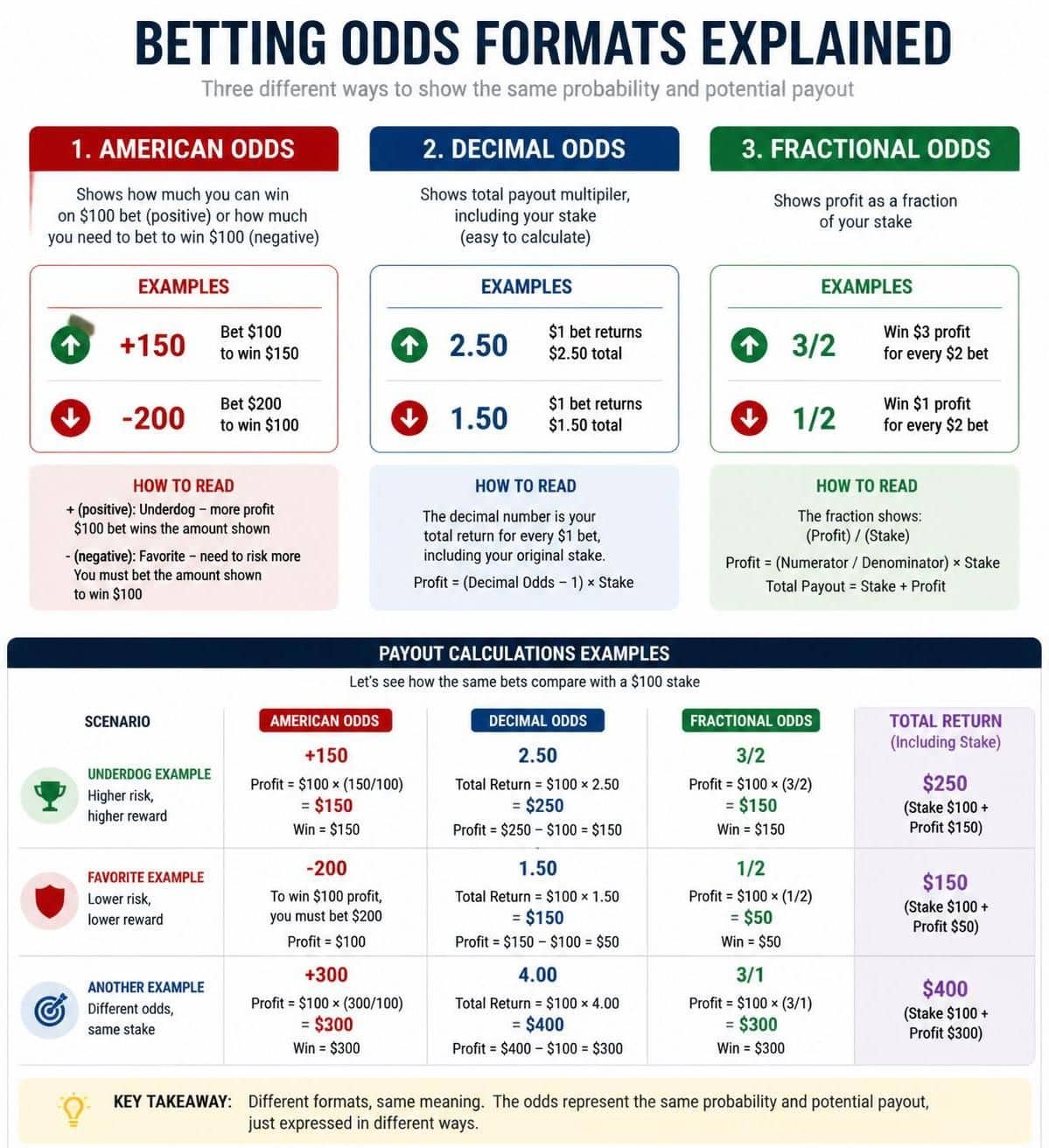
Predominantly used across the United States, the American odds format is instantly recognizable for its use of plus and minus signs—symbols that differentiate favorites from underdogs. Positive odds represent how much profit you stand to gain from a $100 stake, while negative odds indicate how much you must wager to win $100.
For instance, a +200 odds means betting $100 will yield $200 profit plus the $100 stake back, totaling $300. This suggests the bookmaker considers the outcome less likely. Conversely, a -150 odds implies risking $150 to win $100, a reflection of a favored outcome with greater chance but smaller payout. This system allows bettors to readily gauge both risk and reward, given they understand that winnings always include the original stake.
Decimal Odds: Simplifying Calculations
Decimal odds have gained global popularity due to their straightforwardness. Here, the odds reflect the total return on a $1 bet, including the stake. For example, an odds value of 2.50 means a $100 wager returns $250 — the sum of $150 profit and the initial stake.
The beauty of decimal odds lies in their ease of use. Calculations require only multiplying the stake by the odds to determine total returns, making it ideal for those exploring complex markets like parlays or spread betting. For example, if one selects 3.00 decimal odds, that equates directly to +200 American odds, denoting a 33.3% implied probability that guides decision-making.
Fractional Odds: Traditional Roots in Racing and Beyond
Fractional odds retain their stronghold, especially in the UK and Ireland, commonly used in horse racing and traditional sports betting markets. Displayed as a ratio, such as 5/1 or 3/2, these odds represent profit relative to the stake. A 5/1 bet means for every $1 wagered, $5 is the profit, plus the original $1 stake returned if the bet wins.
Fractional odds provide an intuitive grasp of potential profit but require a bit more mental math for total return and implied probability. For example, converting 5/1 to decimal involves dividing 5 by 1 and adding 1, resulting in 6.00. This conversion enables bettors to harmonize insight across global markets and find the most favorable betting opportunities.
Putting Odds Conversion into Practice
Understanding how to translate between these formats is essential for effective line shopping and finding value across different sportsbooks. The key formulas include:
- American positive to decimal: (American odds ÷ 100) + 1
- American negative to decimal: (100 ÷ absolute American odds) + 1
- Fractional to decimal: (numerator ÷ denominator) + 1
- Decimal to fractional: subtract 1, then express as fraction
For bettors juggling multiple markets, these conversions aid in comparing the odds for the same event, enabling optimal betting choices. Engaging with tools such as online odds converters further simplifies this process, allowing a deeper focus on strategy instead of arithmetic.
For expanded explanations and advance strategies on reading betting odds, resources like comprehensive coaching provide valuable insights.
Understanding Betting Markets: Dynamics, Influences, and Types
Beyond odds themselves, the betting markets encompass the variety of options available to punters, each shaped by the sporting event’s parameters and bookmaker offerings. These markets constantly evolve in response to real-world factors and betting patterns, influencing odds and betting strategies.
Market Types: From Moneyline to Parlays
Betting markets can range from straightforward moneyline bets to complex parlays and spreads. Moneyline bets focus on picking the outright winner; odds here mirror the probability of victory directly. Spread betting adds a point handicap to level the playing field, challenging bettors to predict not just the victor but the margin. Parlays bundle multiple bets into one, increasing both risk and potential return but demanding higher accuracy for success.
Each market type suits different betting strategies. For example, bettors seeking steady, lower risk options might gravitate towards moneyline or spread bets, where probabilities are more transparent. Conversely, risk-tolerant bettors may prefer parlays or futures that offer lucrative payouts but depend on multiple accurate predictions.
Market Influences: How Odds Shift
Odds and markets fluctuate due to a multitude of factors that bettors must consider. Recent team injuries, weather conditions, lineup changes, or even the volume of money wagered on each side can prompt sportsbooks to adjust odds. These adjustments are designed to balance liabilities and entice bets on either side. Savvy bettors monitor these shifts closely to exploit value bets — those positions where their evaluation of the event’s probability exceeds that implied by the odds.
The ability to react swiftly to line movements can substantially impact profitability. Tracking market changes requires vigilance and access to timely information, often supported by data feeds and expert analysis platforms, making it a key component of professional betting strategies.
Leveraging Market Variety for Better Returns
Exploring niche or less popular markets can uncover valuable betting opportunities often overlooked by the majority. Sports such as tennis, golf, or esports offer diverse market types, from set betting to player props, expanding the array of possible wagers. These markets might reflect less efficient pricing, providing more frequent chances to find favorable odds.
Harnessing a deep understanding of market mechanics, bettors combine different bet types, including spread betting and parlays, to design tailored betting plans aligned with their risk appetite and sports knowledge.
Mastering Value Bets and Line Shopping to Increase ROI
Identifying value bets is the central pursuit for any sharp sports bettor. A value bet occurs when the bettor’s estimation of an outcome’s probability is higher than the probability implied by the odds. Spotting these opportunities requires a blend of research, statistical modeling, and flexibility in market selection.
Calculating Implied Probability: The Bettor’s Compass
Every set of odds carries an implied probability, the bookmaker’s view of an event’s likelihood, adjusted for their margin or vig. Converting odds into implied probability helps bettors determine whether a wager offers an edge.
| Odds Format | Calculation | Example | Implied Probability |
|---|---|---|---|
| Positive American | 100 ÷ (Odds + 100) | +200 | 33.3% |
| Negative American | Odds ÷ (Odds + 100) | -150 | 60% |
| Decimal | 1 ÷ Odds | 2.00 | 50% |
| Fractional | Denominator ÷ (Numerator + Denominator) | 3/1 | 25% |
Proper conversion clarifies when to stake and when to hold back. It enables bettors to filter out arbitrarily favored options and focus on genuine value bets, boosting long-term profitability.
Line Shopping: Maximizing Value Across Betting Markets
Since odds vary between sportsbooks, the practice of line shopping—comparing offers for the same bet—can significantly improve returns over time. Differences that appear minor on a single bet compound extensively throughout a season. Maintaining accounts with multiple platforms allows bettors to seize the highest available odds, an essential habit affirmed by expert betting guides.
Combined with reliable bankroll management and disciplined staking, line shopping ensures that bettors are not conceding potential gains unnecessarily, even in markets as dynamic as spread betting or parlays.
Betting Odds Formats Comparison
Explore different odds formats, understand how to convert between them, their profit calculations, and their implied probability.
American Odds
Examples: +200, -150
Positive odds show profit on a $100 stake.
Negative odds show amount to stake to win $100.
To Decimal:
- If odds ≥ 100:
decimal = (American / 100) + 1 - If odds ≤ -100:
decimal = (100 / |American|) + 1
Implied Probability (%):
If odds > 0: = 100 / (American + 100) * 100
If odds < 0: = |American| / (|American| + 100) * 100
Example: +200 means betting $100 wins $200 profit.
Decimal Odds
Examples: 3.00, 1.67
Represents total payout (stake + profit) per unit staked.
To American:
- If decimal ≥ 2:
American = (decimal - 1) * 100 - If decimal < 2:
American = -100 / (decimal – 1)
Implied Probability (%):
= (1 / decimal) * 100
Example: 3.00 means $1 bet returns $3 total.
Fractional Odds
Examples: 2/1, 2/3
Shows profit relative to stake, e.g. 2/1 means 2 units profit for 1 unit staked.
To Decimal:
decimal = (numerator / denominator) + 1
Implied Probability (%):
= denominator / (numerator + denominator) * 100
Example: 2/1 means bet $1 to win $2 profit.
Odds Conversion Calculator
Essential Betting Strategies for Navigating Odds and Markets Effectively
Successful sports betting blends knowledge of odds with disciplined strategies and a keen understanding of betting markets. Mastering this interplay reduces risk and sharpens decision-making. Whether betting on moneyline, spreads, or parlays, each approach requires nuanced adjustments.
Managing the Bookmaker’s Margin (Vig)
Every sportsbook incorporates a margin, or vig, in its odds, ensuring profitability regardless of outcomes. For bettors, recognizing the vig’s impact on returns is crucial. For example, what might look like an evens bet could effectively cost more due to odds like -110 on both outcomes. Over time, this subtle handicap can erode profits if unaccounted for.
A bettor who understands the vig will seek markets or situations where it’s minimized or strive for bets that offset the margin through superior research or value identification. It’s a strategic battleground where the most disciplined and informed bettors gain an edge.
Bankroll Management: Protecting and Growing Your Investment
Effective bankroll management is a backbone of sustainable sports betting. It involves setting staking limits based on the overall fund, avoiding impulsive decisions, and allocating bets proportionally to perceived value. For instance, many bettors recommend wager sizes of 1–5% of the bankroll per bet, adjusting stakes as the bankroll grows or contracts.
Disciplined bankroll management helps weather losing streaks and capitalizes on hot streaks without jeopardizing longevity in the market. Coupled with informed reading of betting odds and markets, it enhances the chance of positive outcomes.
Applying Advanced Tactics: Arbitrage, Hedging, and Correlated Parlays
Experienced bettors employ advanced tactics like arbitrage—betting opposing outcomes across different books to guarantee profit—hedging to mitigate potential losses, or constructing correlated parlays to boost payout by leveraging related bets. Each requires a thorough command of odds interpretation and market timing, reinforcing that deep understanding is foundational.
To dive deeper into sophisticated strategies, consult expert resources on enhancing betting tactics that cater to both novices progressing to seasoned pros.
Common Errors and Pro Tips in Understanding Odds and Betting Markets
Even the most enthusiastic bettors occasionally stumble over common pitfalls. Highlighting these mistakes offers a roadmap to more consistent success:
- Confusing profit with total return: Misunderstanding that a +200 odds on a $100 bet returns $300 total, not just $200 profit, can skew bankroll planning.
- Misreading negative odds: A favorite is not a safe bet regardless of odds; the stake needed to win $100 is higher, reflecting risk management.
- Ignoring the vig: Overlooking the bookmaker’s margin erodes long-term profitability.
- Not shopping for the best line: Settling for the first odds seen often means leaving potential value on the table.
- Betting on emotion rather than value: Betting on a favorite team without regard to true probability leads to losses.
Conversely, integrating these pro tips strengthens outcomes:
- Maintain multiple betting accounts to compare odds effectively.
- Regularly convert odds to implied probability to spot value bets.
- Closely monitor market news to anticipate line moves.
- Implement strict bankroll management and avoid chasing losses.
Mastery over odds and betting markets is a journey combining analytical skill and disciplined strategy, elevating sports betting from mere guessing to informed decision-making.
How do betting odds reflect both payout and probability?
Odds convey the potential payout and signal the implied probability assigned by the sportsbook, helping bettors assess risk versus reward.
What is the difference between American, Decimal, and Fractional odds formats?
American odds use plus/minus signs to show profit or stake requirements, Decimal odds display total returns straightforwardly, and Fractional odds express profit against stake as a ratio.
How can I identify value bets in sports betting markets?
By converting odds to implied probability and comparing that to your own assessment, you can spot bets where the bookmaker’s odds underestimate the real chance of an outcome.
Why is line shopping important for bettors?
Comparing odds across different sportsbooks allows bettors to maximize returns and exploit better-value opportunities, which compounds profit over time.
What common mistakes should be avoided when interpreting betting odds?
Misunderstanding total returns, ignoring vig, and betting emotionally rather than based on value are prevalent errors that reduce betting success.