


Mastering sports betting can often feel like navigating a complex maze, especially for beginners eager to find their footing. Each wager holds the promise of excitement and profit, but behind every successful bet lies a blend of strategic thinking, risk management, and deep understanding of odds and markets. This comprehensive article sheds light on essential betting guides and strategies tailored specifically for novices. By breaking down the core principles of sports betting, clarifying the types of wagers, and revealing methods to manage bankroll and assess value, beginners can embed confidence into their betting journey right from the start.
Sports betting in 2026 is no longer just about guessing outcomes; it’s a disciplined craft where knowledge triumphs impulse. Savvy bettors today employ advanced tactics, from analyzing coaching matchups to dissecting staking systems that optimize returns while minimizing potential losses. Embracing these tips while maintaining responsible gambling habits allows newcomers to enjoy the thrill of wagering without jeopardizing their financial health. Through practical insights and real-world examples, this guide offers a well-rounded foundation for those ready to transform casual interest into smart sports betting practice.
Understanding the Essentials of Sports Betting: Key Concepts and Bet Types
For anyone stepping into the world of sports betting, a clear grasp of the foundational elements is critical. At its core, a bet is a simple prediction coupled with a stake: predicting the outcome of a sporting event and wagering a certain amount of money on that prediction. The potential return hinges on the odds provided when the wager is placed, which reflect both the implied probability and the payout ratio on the bet.
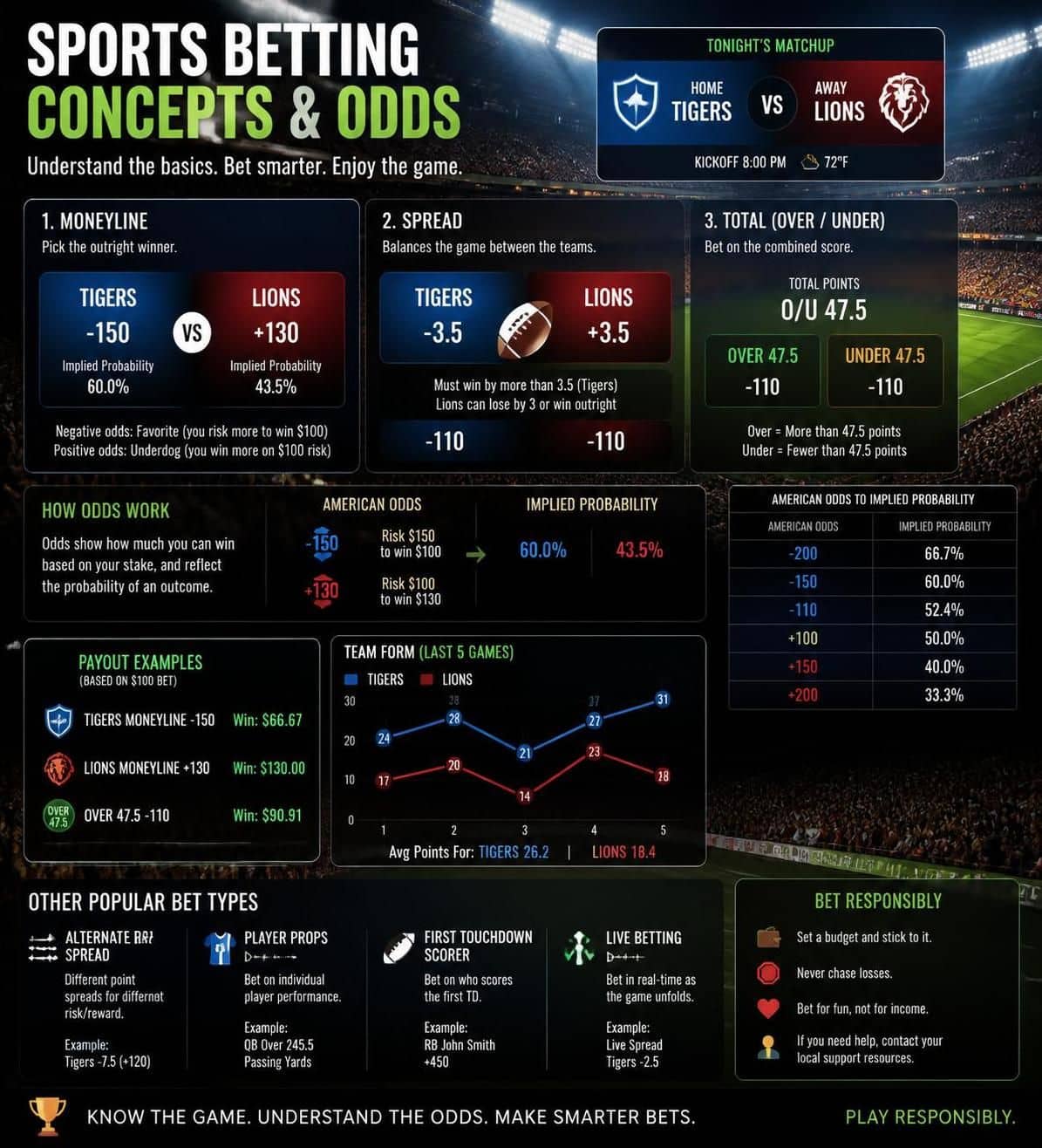
There are several fundamental bet types beginners should get familiar with before moving on to more complex wagers. Moneyline bets represent the simplest form: just picking the outright winner of a game, match, or event. This simplicity makes it ideal for novices. Meanwhile, the point spread is designed to level the playing field by allotting a handicap to the favored team. For example, if a football team is favored by 7 points, that team must win by more than 7 points to secure a winning bet on the favorite side. Conversely, the underdog can lose by fewer points than the spread or win outright for the bet on them to pay off.
Totals bets – also known as over/under – hinge on the combined score or performance metrics in a game rather than who wins. Bettors wager on whether the total score will be above or below a certain number set by oddsmakers. This form appeals to those who have studied teams’ defensive abilities or tempo, enabling more nuanced wagers independent of the outright winner.
Once comfortable with these foundational bets, exploring prop bets (specialized wagers on specific events within a game), parlays (multiple bets linked together for a bigger payout but increased risk), and futures (bets placed on long-term outcomes such as season championships) becomes feasible. However, these carry more risk and complexity and are best approached after developing a solid base.
Understanding odds is equally fundamental. In sports betting today, you’ll encounter three primary formats: American, decimal, and fractional. American odds use positive and negative signs: a minus sign (e.g., -150) indicates the favorite and specifies how much you must wager to win $100. A plus sign (e.g., +130) signals the underdog and represents how much you’d win on a $100 wager. Decimal odds are widely used internationally and provide an easy way to calculate total payout by multiplying the stake by the decimal figure. Fractional odds, common in the UK, display profit relative to the stake (e.g., 5/1 means you win $5 for every $1 wagered). Practicing conversion among these formats helps build fluency and sharpens understanding.
For fresh starters, learning to read and interpret these odds is indispensable. Aspects such as implied probability—derived by transforming odds into percentages—help discern the realistic chances behind a wager and enable bettors to spot value bets, where the bookmaker’s listed odds underestimate the real likelihood, thus offering a potential edge.
Bankroll Management and Risk Strategies Vital for Beginners
One of the pillars of sustainable sports betting is managing a bankroll effectively. Without a proactive approach to risk management, even a well-researched bet can jeopardize your financial stability. Understanding bankroll management helps beginners preserve their betting funds over the long term and avoid emotional decision-making which often leads to rash, impulsive wagers.
A practical starting point is to establish a fixed bankroll — the total amount set aside exclusively for wagering. This should be an amount that doesn’t affect essential expenses or personal financial goals if lost. Dividing this bankroll into smaller units, typically 1-3% per wager, safeguards against severe depletion from a bad run of results. For instance, a bankroll of $1,000 with a 2% unit size translates to $20 stakes per bet, an amount manageable enough to weather ups and downs.
Staking strategies come into play to optimize money management. Flat staking—betting the same amount on every wager—is ideal for beginners for its simplicity and discipline. More advanced bettors might employ variable staking schemes where bet sizes fluctuate in accordance with confidence levels or calculated edges, but these require skillful analysis to avoid escalating risk. Keeping a detailed betting log where stakes, outcomes, and the rationale behind each wager are recorded can lead to progressive strategy improvements by objectively identifying strengths and weaknesses over time.
Successful bettors also learn to set realistic goals, distinguishing between short-term variance and long-term profitability. Chasing losses frequently results in overspending and emotional stress, so maintaining composure is essential. Establishing stop-loss limits and cooldown periods prevents impulsive behavior and encourages measured betting practices.
| Bankroll Management Concepts | Implementation Examples |
|---|---|
| Bankroll Segmentation | Divide total funds into units of 1-3% depending on risk tolerance |
| Flat Staking | Consistent wager amounts regardless of bet confidence |
| Variable Staking | Adjust bet sizes based on confidence level or calculated edge |
| Stop-Loss Limits | Set maximum daily or weekly loss thresholds to preserve bankroll |
| Bet Tracking | Maintain a log for all bets to analyze performance and refine strategies |
Adopting these risk management principles early can extend your betting lifespan and improve overall results. For detailed insight into staking and bankroll approaches, consider reading extensive betting guides that explore various methodologies and real-world examples.
How to Research and Find Value in Sports Betting Markets
Thorough research distinguishes professional bettors from casual gamblers. Sports betting is no longer reliant on luck or intuition alone; data-driven decisions fueled by comprehensive analysis deliver consistent advantages. Whether you’re betting on football, basketball, or niche sports, identifying value is the game changer.
Key areas for analysis include team form, player injuries, tactical matchups, coaching strategies, and even weather conditions that could affect gameplay. Public betting trends also provide context, indicating how money is flowing in the market, helping spot contrarian opportunities where the general betting public might be overestimating favorites or trending toward overvalued lines.
Line shopping is another crucial strategy — comparing odds and lines across multiple platforms ensures you don’t leave potential profit on the table due to inferior pricing. Beginners should cultivate the habit of checking diverse sources before placing a bet, especially when margins are thin. Supplement this with use of statistical websites and advanced metrics tools to enhance prediction accuracy.
Blending qualitative insights with quantitative approaches enriches your betting edge. For example, a star player’s absence due to injury might be underappreciated in the odds movement, presenting a value opportunity. Similarly, understanding coaching tactics can clarify why a team’s performance modulates under certain match circumstances.
Practical tools and models, such as spreadsheets comparing implied probabilities from odds against your own calculations, further hone your betting judgment. Developing this skillset helps shift from random wagers to informed, value-based betting strategies.
Betting Guides: Comprehensive Strategies for Beginners
Interactive Step-by-Step Guide to Smart Betting
Choosing Suitable Sports and Markets for Beginners
With the vast array of sports and markets available in 2026’s betting landscape, new bettors should target familiarity and simplicity first. Starting with sports and leagues you know well significantly improves your capacity to research effectively and make judicious wagers. Trying to dive into unfamiliar sports leads to uninformed betting and lower chances of success.
Among the many markets, novices are advised to focus on straightforward options like moneyline and totals (over/under) bets. These are easier to follow and less impacted by the intricacies of complex betting systems. Avoid complex bets such as parlays, teasers, and exotic props until a solid grasp of basic wagers and strong bankroll management are established.
Single bets, as opposed to multi-leg parlays, also limit risk while providing clearer feedback on bet quality and outcomes. It’s in this focused approach that beginners build confidence and refine their betting instincts, preparing for more advanced strategies later.
Many sportsbook platforms provide tutorials and articles on markets, odds, and rules — taking advantage of these educational resources accelerates learning. For a detailed walkthrough tailored to new bettors, exploring comprehensive betting 101 guides provides a solid knowledge boost.
As you gain experience, expanding into different sports or game props may diversify your portfolio and enhance enjoyment without compromising control.
Videos like this one offer visual explanations of essential betting strategies and how to apply them in real scenarios, often highlighting mistakes to avoid and tactics to leverage.
Practicing Responsible Betting: Tools and Habits for Sustainable Wagering
Finally, the cornerstone of anyone’s betting career is responsibility. Keeping betting fun, exciting, and safe requires self-awareness and disciplined control. Many betting platforms now integrate tools to support healthy gambling behaviors.
Setting deposit limits restricts the maximum funds you can add over a predefined period, curbing impulsive overspending. Cooldown periods create mandatory breaks after intense betting sessions, allowing bettors to regain perspective and avoid chasing losses due to frustration or emotional bias.
Self-exclusion options allow bettors to temporarily or permanently ban themselves from placing wagers, providing safety nets if gambling ever becomes problematic. Maintaining clear time and money boundaries, and understanding that betting is entertainment rather than a guaranteed income source, preserves mental well-being and financial health.
Moreover, recognizing when to step away can prevent the escalation of problem gambling. Reliable professional resources are accessible through various organizations and platforms for those seeking support and guidance.
Responsible habits complement strategic approaches, protecting your bankroll and mindset alike. By combining risk management techniques with these tools, beginners position themselves for a sustainable and enjoyable betting journey well beyond their early wagers.
What are the easiest bets for beginners in sports betting?
The simplest bets to start with are moneyline bets, where you pick the winner of an event, point spreads, which level the playing field with handicaps, and totals (over/under bets), focusing on combined scores.
How important is bankroll management for beginners?
Bankroll management is critical as it helps protect your betting funds from being wiped out during losing streaks and encourages disciplined staking that supports long-term profitability.
What does ‘finding value’ mean in betting?
Finding value means identifying bets where the odds underestimate the true probability of an outcome, thus offering the potential for profitable wagers over time.
Why should beginners avoid parlays and exotic bets initially?
Parlays and exotic bets involve higher risk and complexity, which can lead to quick losses. It’s better to master simple single bets and bankroll management first.
What tools can help maintain responsible betting?
Deposit limits, cooldown periods, and self-exclusion options help manage how much and how often you bet, fostering responsible habits that keep betting fun and safe.