


Embarking on the journey to professional sports betting goes far beyond merely picking winners. In today’s 2026 betting landscape, savvy bettors leverage sophisticated strategies grounded in analytical rigor, psychological insight, and money management. Advanced betting techniques empower bettors to identify value bets, manage risks effectively, and optimize returns. These methods transform sports wagering from a game of chance into a disciplined endeavor that balances data-driven decision-making and emotional control.
In an era where hundreds of betting markets thrive around the globe, mastering advanced betting requires understanding dynamic odds shifts, exploiting inefficiencies in pricing, and applying mathematical concepts to sizing wagers. Whether betting on major leagues or niche sports, the right mix of skillsets and tools is essential to consistently beating the market. This comprehensive exploration reveals key betting strategies, including bankroll management, value identification, and psychological discipline, providing a framework for bettors aiming to excel in an increasingly competitive environment.
Key themes we will delve into include the practical application of the Kelly Criterion for bet sizing, advanced handicapping using regression models and situational analysis, and the nuanced art of line shopping and arbitrage. Additionally, applying psychological principles to overcome common cognitive biases is vital for maintaining a long-term edge. Equipped with this knowledge, bettors can navigate fluctuating sports markets with confidence, gleaning sports betting tips and betting systems that elevate their wagering game while managing risk efficiently.
A deep understanding of odds calculation and probability assessment forms the backbone of successful sports betting ventures. By integrating statistical analysis and value betting concepts, bettors position themselves to capitalize on pricing errors and directional market movements. Advanced bettors also track their performance meticulously, using bettor databases and analytic tools to reinforce discipline and continuously refine their strategies. This holistic approach, supported by wagering guides and betting analytics, represents the gold standard for serious sports investors.
As sports betting technology evolves and market dynamics shift, staying abreast of the latest innovations and strategies is paramount. From exploring emerging prop markets to employing hedging and middling tactics, this guide showcases how professional bettors transform complex data into actionable insights. By mastering these facets, you gain a tactical advantage that transcends luck, setting the stage for sustainable profitability in the field of sports wagering.
In brief:
- Bankroll management is critical for sustainability, with the Kelly Criterion providing a scientific foundation for bet sizing.
- Value betting exploits discrepancies between calculated probabilities and odds to achieve a long-term edge.
- Advanced handicapping integrates regression analysis and situational factors to improve prediction accuracy.
- Line shopping, arbitrage, and hedging are essential tactics to maximize returns and minimize risks.
- Psychological discipline prevents common pitfalls such as chasing losses and emotional betting.
- Detailed tracking and performance analysis enable continuous improvement and refinement of betting strategies.
- Utilizing a broad array of betting markets, including props, futures, and live bets, opens additional opportunities for value.
Professional Bankroll Management: The Backbone of Long-Term Success
One of the most fundamental yet overlooked aspects of advanced betting strategies is bankroll management. Professionals recognize that consistent profitability is not just about winning individual bets but about preserving and growing their betting capital over time. This is why successful bettors are meticulous about how much they stake and under what conditions they increase or decrease their wager sizes.
The Kelly Criterion and Optimal Bet Sizing
The Kelly Criterion has become a staple in the arsenal of professional bettors aiming to optimize bet sizing mathematically. Rather than blindly wagering a fixed amount, the Kelly Formula calculates the ideal proportion of your bankroll to risk based on the odds and your perceived edge. The formula is expressed as: (bp – q) / b, where:
- b is the decimal odds minus 1 (essentially the net odds received),
- p represents the probability of winning your bet,
- q is the probability of losing, which is 1 – p.
For example, if you believe a team has a 60% chance of winning (p=0.6) and the odds offered are 2.5 (b=1.5), the Kelly calculation yields (1.5 * 0.6 – 0.4)/1.5 = 0.4 or 40%. This means you’d wager 40% of your bankroll on this bet. However, many professionals use a “fractional Kelly” to reduce volatility, betting only a fraction of this amount to manage risk better.
Unit-Based Betting and Bankroll Allocation
Another critical concept is measuring your bets in units rather than raw dollars. A unit typically comprises 1-2% of your entire bankroll, ensuring that single losing streaks don’t decimate your funds. For instance, if you have a bankroll of $10,000, one unit might be set at $100 to $200. Here’s a practical breakdown:
| Bankroll Size | 1 Unit (1-2%) | Maximum Bet (5 Units) | Total Bets Possible |
|---|---|---|---|
| $1,000 | $10-$20 | $50-$100 | 50-100 bets |
| $5,000 | $50-$100 | $250-$500 | 50-100 bets |
| $10,000 | $100-$200 | $500-$1,000 | 50-100 bets |
This system enables bettors to maintain consistency in wager sizing and withstand variance. It inherently aligns with risk management principles and forms a backbone for a sustainable sports betting career.
Careful bankroll management combined with solid wagering guides is an indispensable foundation that separates recreational bettors from professionals. Without it, even the most accurate picks may lead to ruin.
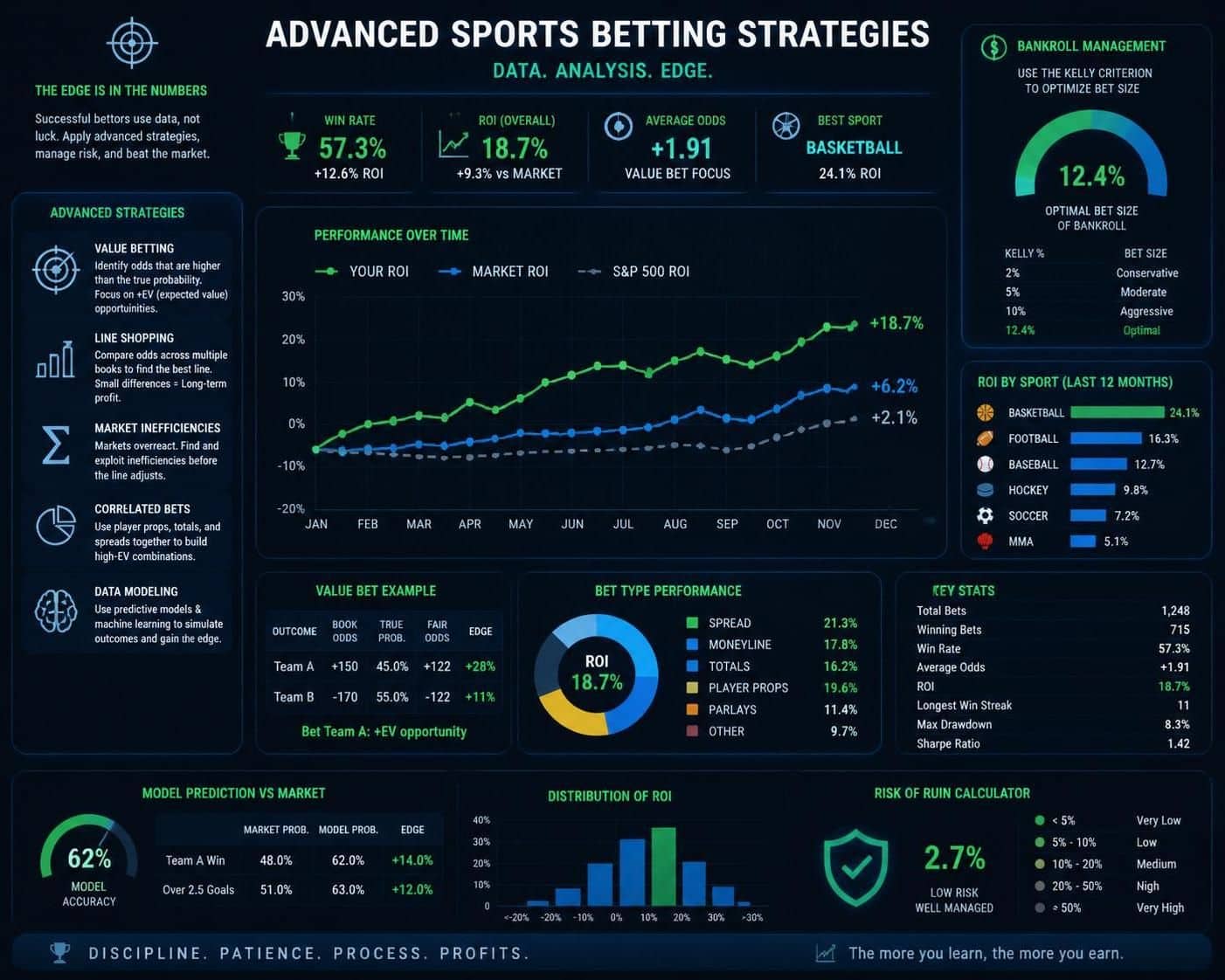
Harnessing Value Betting to Capitalize on Market Inefficiencies
At the heart of all successful sports betting lies the pursuit of value betting. This entails identifying wagers where the published odds underrepresent the true probability of winning. Finding this value systematically can turn an advantage into sustained profitability.
Understanding and Calculating Implied Probability
Odds represent market consensus perceptions of outcomes, transformed into an implied probability. Understanding how to convert odds into probability is fundamental for spotting mispriced bets. For American odds, the formulas are as follows:
- For favorites (negative odds): Odds / (Odds + 100) — e.g., -150 odds imply 150 / (150 + 100) = 60% winning chance.
- For underdogs (positive odds): 100 / (Odds + 100) — e.g., +120 odds imply 100 / (120 + 100) = 45.5% winning chance.
If your independent analysis points to a winning probability better than the implied, you’ve found a value bet. For example, if you estimate a team has a 55% chance to win, but the market odds imply only 45.5%, this mismatch signals opportunity.
Where to Find Value in 2026 Sports Markets
Value does not appear uniformly across every wager. It is more commonly spotted in these conditions:
- Less popular sports or niche leagues where lines receive minimal sharp attention.
- Prop markets featuring many variables, often priced inefficiently.
- Situations where public money heavily skews the odds on one side, creating contrarian opportunities.
- Early betting lines before insiders place large stakes.
These factors create a fertile environment for bettors employing advanced betting techniques to uncover profitable edges.
Mastering value betting requires patience, rigorous data analysis, and constant monitoring of market movements. For deeper insights into how professional bettors refine these strategies, explore comprehensive perspectives on advanced betting systems and how to analyze betting markets effectively.
Refined Handicapping and Statistical Models for Edge Enhancement
While many beginners guess outcomes based on simple stats or team reputation, serious bettors incorporate betting analysis that uses advanced statistical tools and situational factors. This elevates handicapping from guesswork to predictive modeling.
Regression Analysis and Multivariate Models
Regression techniques examine relationships between multiple variables, such as home/away performance, player injuries, weather conditions, and recent form, to create predictive models. Unlike simple averages, these models weight various factors by their influence on outcomes, improving forecast accuracy.
Profiting From Situational Analysis
Situations repeat often in sports, presenting known edges for bettors who spot them. Examples include:
- Back-to-back games: Teams playing consecutive nights often show fatigue that can be quantified.
- Primetime home favorites: Home favorites under a specific point spread (e.g., 3 to 7 points) in marquee games have historically outperformed betting markets.
- Road underdogs with recent covers: Underdogs that covered spreads in previous outings tend to maintain momentum.
- Weather-sensitive teams: Some teams perform notably better or worse under certain weather, affecting play styles.
An example situational system might identify that NFL home underdogs favored by 3+ points in December cover approximately 58% of the time. Applying such data consistently with appropriate risk management can be a winning strategy over many seasons.
Implementing Tactical Betting Techniques: Line Shopping, Arbitrage, and Hedging
Beyond selection skills lies the domain of manual and tactical techniques that maximize returns and mitigate risk, such as line shopping, arbitrage, and hedging.
Line Shopping for Better Odds
Odds fluctuate between sportsbooks, sometimes significantly. By comparing these lines before placing bets, you can secure better value. The differences may look small but compound over many bets, enhancing profitability. Line shopping involves using multiple accounts and staying alert to market changes—this discipline is crucial in high-stakes or high-frequency betting.
Arbitrage Betting to Lock in Guaranteed Profits
Arbitrage betting consists of placing bets on all possible outcomes with different bookmakers to guarantee a profit regardless of the result due to odds discrepancies. Though opportunities are rare and require quick action, the technique exemplifies the analytical precision and rapid response necessary at the advanced level.
Middling and Hedging Strategies
Middling exploits line movements by betting both sides at varying spreads with the chance to win both if the final margin falls within the “middle.” Hedge betting involves placing counter-bets to lock in profits or minimize losses on futures and parlays. While these techniques require careful calculation and timing, they offer protection in volatile scenarios and diversify a betting portfolio.
These diverse tactical approaches underpin modern betting approaches and complement sound handicapping and bankroll management. For readers looking for thorough breakdowns of these topics, betting strategy resources provide detailed guidance suited for intermediate and advanced bettors.
Advanced Betting Techniques Infographic
1. Kelly Criterion Formula
Use the Kelly Criterion to optimize your bet size based on odds and your estimated probability.
Formula:
f* = (bp - q) / b
Where:
b = decimal odds – 1
p = probability of winning
q = 1 – p (probability of losing)
f* = fraction of bankroll to wager
2. Value Betting Calculation
Identify value bets by comparing your estimated probability to the implied probability from odds.
3. Bankroll Management Table
Determine recommended bet size based on your bankroll and risk level.
| Risk Level | Recommended % Bet | Bet Size (USD) |
|---|
4. Key Psychological Traps
- Chasing losses: Increasing stakes to recover past losses.
- Confirmation bias: Favoring info that supports your bet.
- Overconfidence: Overestimating your predictive skill.
- Recency effect: Overweighing recent events.
- Gambler’s fallacy: Believing past outcomes affect future results.
5. Line Shopping Checklist
Tips for finding the best betting lines:
- Compare odds across multiple sportsbooks.
- Look for reduced juice or better margins.
- Consider timing: odds can shift before events start.
- Check for bonuses or promotions enhancing value.
- Use odds comparison tools and aggregators.
Psychological Factors, Record Keeping, and the Path to Consistent Wins
Even the most rigorous betting systems and analytical insights can falter without proper mental discipline. Psychology plays a central role in sustaining profitable sports betting.
Common Psychological Pitfalls
Bettors often fall prey to cognitive biases such as:
- Chasing losses: Increasing bet sizes impulsively after defeats.
- Overconfidence bias: Betting recklessly after winning streaks.
- Favorite team bias: Allowing fandom to override objective analysis.
- Recency bias: Overvaluing recent events over long-term trends.
- Analysis paralysis: Being overwhelmed by excessive information, resulting in indecision.
Implementing Emotional Discipline
Successful bettors cultivate a structured approach by setting strict pre-commitment rules such as maximum daily wagers, stop-loss limits, and scheduled breaks after losing streaks. This reduces impulsive reactions and fosters long-term consistency.
The Importance of Meticulous Record Keeping
Tracking every bet’s details — from stake, odds, reasoning, to closing line value — supports continuous refinement of strategies. Key performance metrics include win rate, ROI, units won, and streak analyses. By regularly reviewing this data, bettors gain clarity on strengths and weaknesses, allowing them to adapt their approach systematically.
Understanding and anticipating variance—knowing that losing streaks are an intrinsic part of betting—is also fundamental. This awareness prevents emotional overreactions and reinforces the concept that sports betting is a marathon rather than a sprint.
For bettors wishing to deepen their knowledge and explore comprehensive frameworks to avoid pitfalls, responsible betting guides offer extensive advice on maintaining healthy betting habits.
How does the Kelly Criterion improve betting outcomes?
The Kelly Criterion improves outcomes by optimizing bet sizes relative to your edge and odds, maximizing growth while controlling risk. Using fractional Kelly can reduce volatility further.
What is value betting and why is it important?
Value betting involves identifying odds that underestimate the true probability of an event, allowing bettors to gain long-term profits by consistently placing wagers where the expected return is positive.
How can bettors avoid common psychological mistakes?
Bettors avoid pitfalls by implementing strict bankroll rules, avoiding chasing losses, staying objective about teams, and regularly reviewing their betting data for insights.
What is line shopping and how does it benefit bettors?
Line shopping is the practice of comparing odds across multiple platforms to find the best price, which increases potential returns and enhances overall profitability.
Why is record keeping critical in advanced sports betting?
Record keeping allows bettors to analyze performance trends, identify profitable strategies, and make data-driven adjustments to improve long-term results.
Mastering these components establishes a robust foundation for anyone eager to engage in advanced sports betting and achieve a consistently profitable approach in 2026 and beyond.