

In the complex and thrilling world of sports wagering, understanding betting lines is crucial to gaining an edge and making informed decisions. As sports betting evolves in 2026, bettors face a vast array of options, from moneyline bets to point spreads and over under betting. Each type carries layers of meaning encoded in odds and numbers, which, when decoded, reveal probabilities, risks, and opportunities. This guide dives deeply into the mechanics of betting lines, helping sports enthusiasts and bettors grasp how to read, interpret, and strategically utilize these lines for successful wagers.
Whether you are a casual fan intrigued by betting guides or a seasoned bettor looking to sharpen your knowledge, mastering how to read betting lines equips you with invaluable tools. From comprehending the difference between decimal and American odds to spotting the subtle shifts in lines that suggest sharp betting action, understanding these elements transforms the betting experience from guesswork to strategic gameplay. This knowledge not only advances your sports betting tips but also enhances your ability to identify value and mitigate risk in an ever-changing market.
Decoding Moneyline Bets: The Foundation of Sports Betting Lines
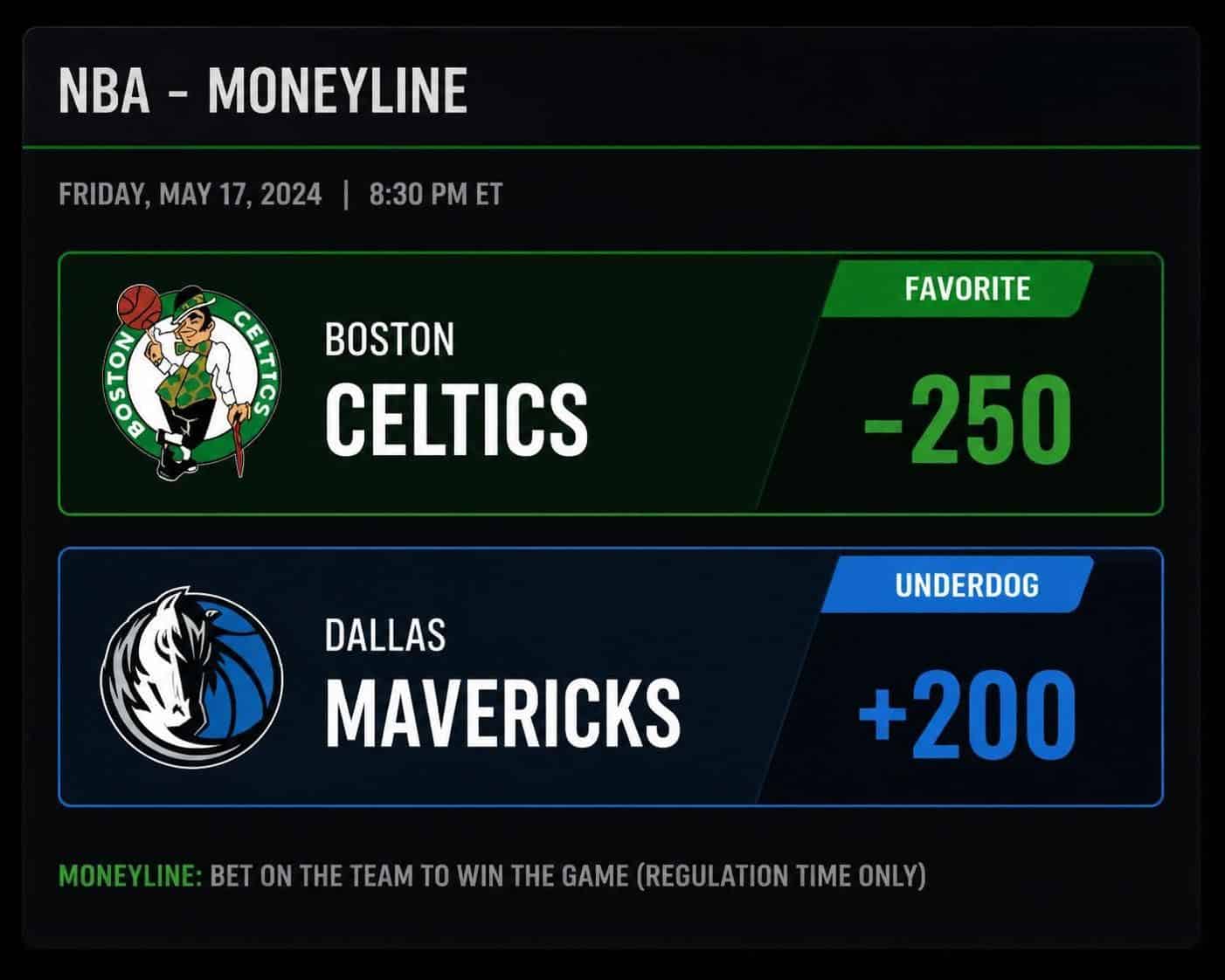
Moneyline bets represent the most straightforward and popular form of wagering across multiple sports. At their core, these bets ask a simple question: which team or player will win? Unlike other bet types, moneyline bets do not involve point spreads or margins — the focus is solely on the outright winner. This simplicity makes moneyline bets an excellent starting point for anyone learning how to read betting lines.
The moneyline uses a notation system featuring plus (+) and minus (–) signs that convey critical information. A minus sign before a number indicates the favorite, while a plus sign designates the underdog. For instance, a line displaying -150 beside a team means that you must risk $150 to earn a profit of $100 if that team wins. Conversely, a +130 line means that a $100 wager will yield $130 profit if the underdog prevails. This system creates an intuitive framework that reflects the implied probabilities of outcomes based on the odds.
Understanding the implications of these numbers is vital. Let’s take a real-world example from football: if Team A is listed at -180 and Team B at +155, Team A is considered the favorite and must win for a bet on them to pay off. A bettor must invest $180 to win $100 on Team A, while a $100 bet on Team B returns $155 if they pull off the upset. The discrepancy between these figures reflects the bookmaker’s margin, commonly known as the vig or juice. This margin is the commission charged by sportsbooks to balance risk and ensure profitability.
Beyond their simplicity, Moneyline bets offer nuanced strategic value. A moneyline of +200 implies a 33.3% chance of winning. If an informed bettor’s analysis and data suggest the actual probability is higher, say 40%, this represents a value bet. Identifying such opportunities is the essence of profitable betting strategies. According to extensive analysis during recent NFL seasons, significant moneyline discrepancies frequently arise in divisional matchups, where public sentiment tends to inflate the favorite’s odds. This creates openings for savvy bettors who understand the dynamics of line interpretation.
Moneyline bets also serve as a gateway into learning more complex betting lines, offering a clear, quantifiable way to test understanding of odds and implied probabilities. By mastering moneyline basics, bettors build confidence and analytical skills that are transferable to other bet types like point spreads and totals.
Mastering Point Spreads: Betting on Margins and Game Dynamics
Point spreads represent one of the most prominent betting lines in sports such as football and basketball. Rather than simply picking a winner, bets against the spread focus on the margin of victory. Sportsbooks set a spread number, which acts as a handicap designed to equalize perceived differences between teams. To succeed in these bets, favorites must win by more than the spread, while underdogs either win outright or keep losses within the spread threshold.
Interpreting point spreads accurately is fundamental for bettors seeking advanced wagering strategies. Consider a scenario where the Buffalo Bills are favored by 3.5 points against the Miami Dolphins, expressed as -3.5 for the Bills and +3.5 for the Dolphins. A bet placed on the Bills at -3.5 means they must win by at least 4 points for the wager to pay. Betting the Dolphins at +3.5 allows victory if they win outright, or if they lose by 3 points or fewer. The half-point, known as the “hook,” eliminates potential ties or pushes, ensuring a decisive result for bettors.
Whole-number spreads such as -3, -7, and -10 hold notable significance in NFL betting, representing the most common final victory margins. A spread of -3 carries a risk of a push if the favored team wins by exactly 3 points, pushing bettors’ stakes back without a win or loss. Understanding these key numbers is a critical component of evaluating the value of moving half a point in the spread. For instance, shifting from -3 to -2.5 can substantially reduce push risk, enhancing the overall value of the bet.
The price attached to point spreads typically formats as -110, which means risking $110 to win $100. However, this commission can shift to reflect betting patterns. An example might show the Bills at -3.5 with a line of -105 and the Dolphins at +3.5 with -115, suggesting sharper money is backing the underdog. Recognizing these subtle price shifts and what they indicate about market behavior empowers bettors to identify value or avoid inflated prices.
Point spreads also adjust due to factors like injuries, weather, or public betting action—understanding why lines move and how to interpret that movement is critical for bettors seeking to gain an edge. Being informed about the dynamics of lines enhances decision-making and aligns with important sports betting tips that emphasize timing and value hunting. For a deeper dive into point spreads and their strategic intricacies, refer to comprehensive resources offering step-by-step explanations and examples in betting guides.
Three Core Odds Formats Explained: American, Decimal, and Fractional
One of the first obstacles in learning how to interpret betting odds is the diversity of formats used worldwide. Sports betting odds primarily appear in three formats: American, Decimal, and Fractional. Each format conveys the same mathematical information in a unique style, and mastering them enriches your ability to compare lines and spot advantageous wagers.
American odds use plus and minus signs to indicate favorites and underdogs. Positive values show the profit on a $100 stake, while negative values represent the stake needed to win $100. For example, +250 suggests $100 bet wins $250, while -200 means risking $200 to win $100. This dual representation is common in North American markets and can initially confuse those unfamiliar with it. However, simple mental shortcuts—dividing positive odds by 100 to estimate profit per unit staked and dividing 100 by negative odds to gauge return per stake—help clarify the process.
Decimal odds are the most intuitive and widely used globally outside the U.S. They represent total payout including the original stake. A decimal odd of 2.50 means a $1 bet returns $2.50 in total. Calculating potential returns is straightforward: multiply your stake by the decimal number to view total payout. Decimal odds above 2.00 correspond to underdogs, while below 2.00 indicate favorites. This straightforward calculation makes decimal odds ideal for quick line shopping and comparison.
Fractional odds are traditional in the United Kingdom and Ireland and heavily associated with horse racing. Expressed as a fraction such as 5/1 or 3/2, they indicate profit relative to stake. For example, 5/1 means five units won for every one staked. Fractional odds require a bit more mental math but provide historical context and a familiar interface for certain bettor demographics. Converting fractionals to decimals involves dividing numerator by denominator and adding 1, revealing total payout per unit staked.
Understanding how to convert between these formats enhances flexibility and allows accurate cross-market comparisons. For instance, converting a +300 American odd to decimal yields 4.00, or a 3/1 fractional odd. Many bettors use online tools to facilitate rapid conversions, but knowing the underlying formulas fosters deeper comprehension:
- American to Decimal: For positive odds, (Odds / 100) + 1; for negative odds, (100 / |Odds|) + 1.
- Decimal to Fractional: (Decimal – 1), expressed as a fraction.
- Fractional to Decimal: (Numerator / Denominator) + 1.
With this understanding, it becomes easier to interpret odds across different markets and select better betting lines consistently. More detailed explanations with examples can be found in well-regarded sites offering extensive odds explanation and betting guides.
Line Movement & Sharp Money: Understanding Dynamic Betting Lines
Betting lines are not static; they evolve continuously from the moment they are posted until the event begins. Understanding the reasons behind line movement is essential for turning this knowledge into strategic advantage. Dynamic lines reflect new information—whether from injuries, weather, team news, or betting patterns—and interpreting these shifts is a cornerstone of sophisticated betting strategies.
The opening line is typically set by sportsbooks based on statistical models and forecasting data. After opening, the line moves as bets are placed. Sharp money—large bets placed by professional bettors—often causes significant line shifts. When sharp money backs one side heavily, sportsbooks adjust lines to limit exposure and balance the book.
Public money also impacts line movement but in a different way. Heavy betting by recreational bettors on one side can push the line in that direction, sometimes offering value on the opposite side as the market overreacts. Additionally, real-time news such as last-minute injuries or weather conditions can rapidly alter the lines.
A particularly telling phenomenon is reverse line movement. This occurs when the line moves against the direction of the majority of bets. For example, if 70% of bets are on Team A, but the point spread moves to favor Team B, sharp action is likely on the underdog. Spotting reverse line movement provides one of the clearest signals of smart money influencing the market, and recognizing these patterns is an invaluable skill for bettors seeking to capitalize on subtle informational advantages.
Integrating real-time odds comparison tools enables bettors to track line movement across multiple markets simultaneously. This practice reveals where books might be slow to adjust, creating opportunities for advantage players. Mastering line movement and sharp money concepts adds a layer of depth to betting guides, empowering bettors with actionable insights rather than static numbers.
Learning to interpret these subtle shifts also reduces the risk of chasing lines — a common pitfall where bettors place wagers based on reaction rather than strategy. Instead, interpreting line movement as part of a bigger picture enhances long-term profitability and enjoyment of sports betting.
Betting Strategies and Avoiding Common Mistakes in Reading Betting Lines
Developing effective betting strategies depends heavily on understanding betting lines thoroughly and avoiding common errors. Many bettors, especially beginners, confuse total return with profit. For example, seeing a moneyline of +200 and assuming a $100 bet returns $200 total rather than $300 total (stake plus profit) undermines bankroll management. Precision in interpreting odds and payouts preserves betting capital and informs smarter bet sizing aligned with bankroll goals.
Another frequent mistake involves misreading negative odds as less favorable or “bad” bets. Negative odds signify favorites with higher probabilities but smaller payouts, not poor value per se. Overcommitting to short-priced favorites without evaluating implied probabilities leads to diminished returns over time. Conversely, ignoring the vig embedded in odds—essentially the bookmaker’s commission—results in consistent attrition of betting bankrolls. Awareness of vig and shopping for the best available lines enhances returns by minimizing this hidden cost.
Line shopping—the practice of comparing odds across multiple sportsbooks before placing wagers—is arguably the most effective discipline for long-term success. Even small differences in odds can compound over a full season, delivering substantial boosts to profitability. Many professionals maintain accounts with multiple sportsbooks precisely to capitalize on this. Converting all odds into a preferred format, such as decimal, streamlines this process and sharpens betting strategies.
Finally, betting based on value rather than emotion or name recognition is fundamental. Betting lines embed implied probabilities, and only when your analysis reveals that a team or outcome’s true chance exceeds this implied probability does a bet find true value. This discipline transforms casual punting into a data-driven approach aligned with sound principles of risk and reward.
Implementing these principles and avoiding common pitfalls enhances your betting experience, offering steady gains over the long term. Detailed essays on these themes and tips on mastering live betting strategies provide rich learning material for bettors eager to level up their game.
Key Concepts in Reading Betting Lines
Essential Sports Betting Tips for Reading and Using Betting Lines
Here is a list of key takeaways to keep in mind when navigating betting lines:
- Understand the type of bet: Differentiate between moneyline bets, point spreads, and totals (over under betting) to apply the correct interpretation.
- Convert odds formats: Make sure you can read American, decimal, and fractional odds for a comprehensive view.
- Calculate implied probability: Always convert odds to percentages and compare against your own predictions for value.
- Monitor line movement: Recognize why lines move and identify reverse line movement for sharp action insights.
- Shop for the best lines: Compare prices across multiple platforms to maximize value.
- Be aware of the vig: Account for the bookmaker’s margin in your bet sizing and strategy.
- Use data-driven analysis: Leverage statistics, matchup analysis, and external info rather than emotions when placing bets.
Comparative Table of Odds Formats and Implied Probability
| Odds Format | Example | Implied Probability | Profit on $100 Stake | Total Return on $100 Stake |
|---|---|---|---|---|
| American (Underdog) | +200 | 33.3% | $200 | $300 |
| American (Favorite) | -150 | 60% | $66.67 | $166.67 |
| Decimal | 2.00 | 50% | $100 | $200 |
| Fractional | 1/1 (Even) | 50% | $100 | $200 |
How do odds reflect the probability of an event?
Odds incorporate the sportsbook’s assessment of likelihood, adjusted by their margin. By converting odds to implied probability, bettors can compare the odds with their own predictions to find value bets.
What is the difference between moneyline and point spread bets?
Moneyline bets focus on the outright winner, whereas point spread bets involve wagering on the margin of victory, with handicaps leveling the playing field between teams.
How can I use line movement to my advantage?
By monitoring line shifts, especially reverse line movement, bettors can identify where smart money is influencing the market and make more informed wagers accordingly.
Which odds format is recommended for beginners?
Decimal odds are usually considered easiest to understand and calculate, as they directly show total returns including stakes.
Why is line shopping important?
Different sportsbooks often offer varying odds on the same event. Shopping for the best lines ensures that bettors get the maximum possible payout for their chosen wagers.