


In today’s competitive sports betting landscape, understanding the foundational elements of wagering is more crucial than ever. The vast array of bet types, odds formats, and strategies can overwhelm even seasoned sports enthusiasts. However, by mastering the essential rules and adopting disciplined approaches to bankroll management and risk assessment, bettors can significantly enhance their chances of success. This multifaceted discipline goes far beyond simply picking winners; it demands a strong grasp of probability, sharp analytical skills, and a mindset geared for long-term profitability. Across numerous sports and events in 2026, bettors are combining data-driven models with traditional insights, seeking that valuable edge in the ever-evolving market.
As the accessibility of online betting platforms continues to expand, so does the diversity of betting markets, including point spreads, parlays, teasers, and futures. Each presents unique challenges and potential rewards, necessitating thorough knowledge and strategic application. Professional bettors emphasize the importance of not just knowing these bet types but also learning how to interpret odds correctly, recognize value bets, and maintain discipline through proper bankroll allocation. The intersection of these skills forms the backbone of successful, sustainable betting, empowering players to withstand the natural variance inherent in sports outcomes. Whether you’re a newcomer or refining your approach, these essential rules are foundational in navigating the betting world confidently.
Beyond the mathematical and strategic elements, psychological factors play a pivotal role. The temptation to chase losses, the tendency to bet impulsively on favorite teams, or emotional influence in stake sizing are common pitfalls. The most successful bettors are those who recognize these traps early and implement robust self-regulation tactics. In addition, leveraging promotional offers smartly without falling prey to unfavorable rollover conditions can further optimize your betting experience.
The dynamic nature of sports and shifting market conditions require bettors to continuously adapt and learn. Utilizing modern betting tools such as calculators for implied probability, expected value, and optimal staking models helps in transforming raw data into actionable strategies. Coupling these tools with a methodical record-keeping habit allows bettors to analyze past performance and refine tactics accordingly. In this series of betting guides, expert insights and practical advice converge to illuminate the path toward profitable betting — a journey grounded in knowledge, discipline, and strategic execution.
In this article, we delve deep into the fundamental pillars of sports betting, covering everything from the interpretation of various odds formats, essential bet types every bettor should master, effective risk and bankroll management techniques, to common mistakes and how to avoid them. Each section offers detailed explanations, real-world examples, and recommended best practices, designed to equip bettors with the tools necessary to thrive amid the complex betting environment of 2026.
Key Takeaways:
- Understand various odds formats and how to convert between them to identify value bets.
- Master essential bet types such as moneyline, point spread, parlays, prop bets, and futures for a well-rounded strategy.
- Implement disciplined bankroll management to preserve capital and sustain long-term growth.
- Utilize data-driven betting strategies by analyzing expected value and implied probabilities effectively.
- Avoid common pitfalls including chasing losses and over-betting on favorites to protect your bankroll.
- Leverage betting calculators and tools to make smarter and more informed decisions.
Mastering Betting Odds and Their Interpretation for Successful Betting
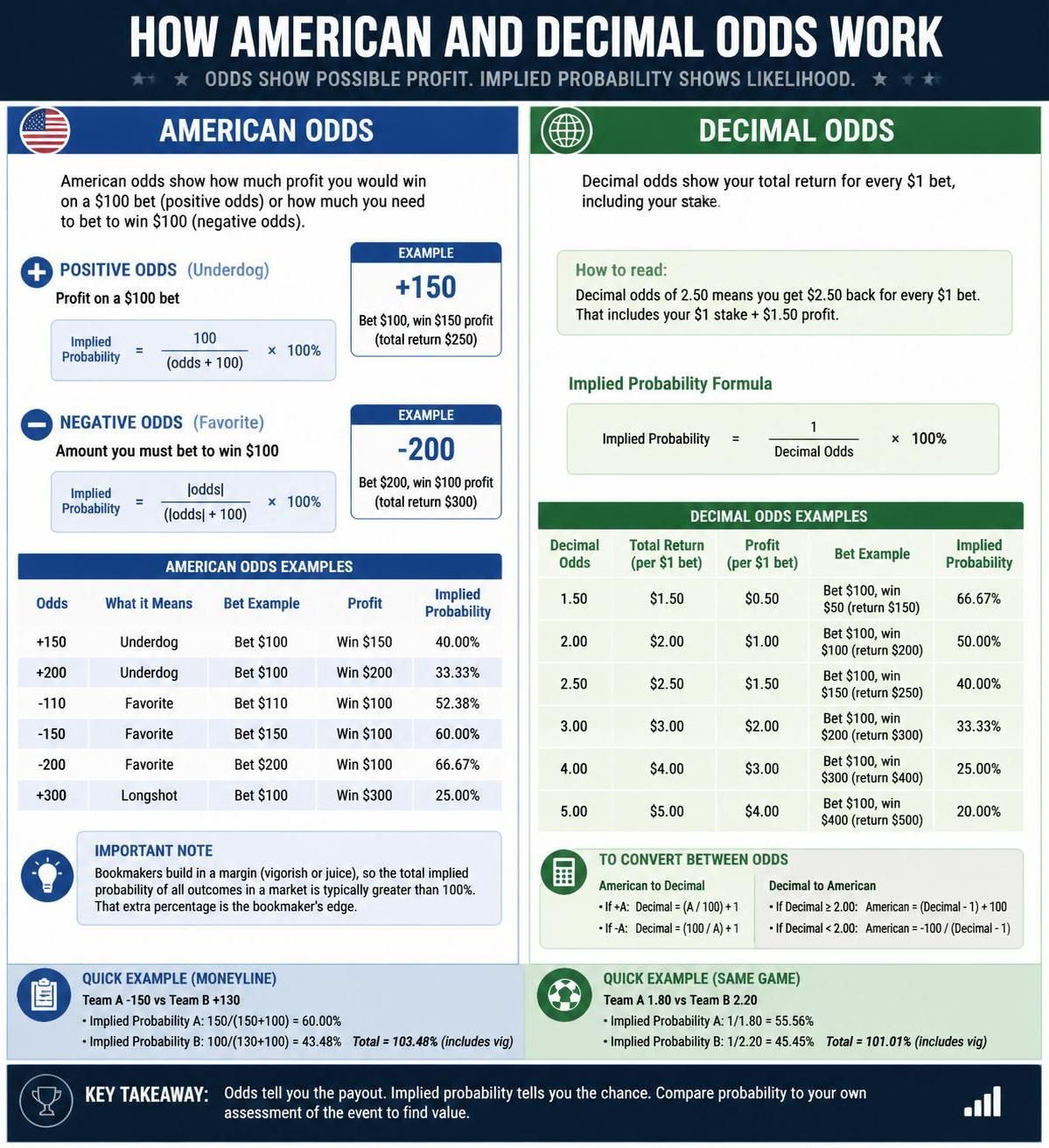
Understanding how betting odds work is foundational for anyone aiming to engage successfully in sports wagering. Odds convey the probability of an event occurring and determine the potential payout. There are three main formats that bettors encounter: American, Decimal, and Fractional odds. Mastery of these formats, particularly the American and Decimal styles which dominate the modern market in 2026, is critical for making informed betting choices.
American odds use positive and negative figures to represent underdogs and favorites respectively. For instance, +200 suggests that a $100 bet could yield $200 in profit, whereas -150 means you need to wager $150 to win $100. Decimal odds, more common internationally, simplify this by showing the total payout including the original stake (e.g., 2.50 means a $1 stake returns $2.50). Fractional odds, often favored in UK markets, express profit relative to stake (5/2 means you win $5 for every $2 staked).
The true skill lies not only in reading odds but in understanding implied probability — the percentage chance that the odds suggest an outcome will occur. Skilled bettors compare this to their own assessments to find positive expected value bets, where their probability estimate exceeds the market’s implied probability. This is a core betting strategy that helps ensure profitability over time.
For example, if you believe a team has a 50% chance to win but the odds imply only 40%, this discrepancy represents a value bet. Consistently identifying and wagering on such opportunities is often what differentiates professional bettors from casual participants. It’s worth noting that bookmakers embed a margin (vig) in their odds, so bettors often need to win slightly more than half their bets to break even, typically around a 52.4% win rate when odds are set at standard -110.
Converters and calculators are valuable tools in this domain. Using an implied probability calculator allows bettors to work back from odds and quantify the likelihood suggested by bookmakers. Moreover, knowing how to convert between formats ensures that no value opportunity goes unnoticed regardless of regional odds presentations. Learning and applying these principles can elevate one’s betting acumen and lay a firm groundwork for strategic wagering.
The importance of line shopping and understanding vig
Line shopping involves comparing odds across different betting markets to find the most favorable payout on a given wager. Even minor differences in odds can substantially impact profitability over many bets, so astute bettors keep tabs on market fluctuations and odds movements.
The vigorish, or vig, is the built-in commission by sportsbooks that ensures their profit regardless of event outcomes. Understanding this fee’s impact on the required break-even win rate is crucial. Without factoring in the vig, bettors might overestimate their chances of profit. This appreciation leads to a more disciplined and calculated betting approach that is vital for sustained success.
For an in-depth understanding of odds and betting strategies, you can explore expert insights on successful betting strategies that include detailed breakdowns of these concepts and practical applications in various sports.
Comprehensive Guide to Essential Bet Types and Their Strategic Use in 2026
Effective sports betting hinges on mastering key bet types. While new bet types continue to emerge, five remain foundational for both beginners and seasoned bettors aiming for profitability. These include moneyline, point spread, over/under totals, parlays, and prop bets. Each carries distinct characteristics, risks, and advantages that suit different betting strategies and markets.
Moneyline Bets – Simple yet Strategic
The moneyline bet is straightforward: simply pick which competitor will win the game or match outright. This bet type is especially useful in contests where the point spread is either unavailable or not advantageous. For example, betting on an underdog with moneyline odds of +130 means a $100 wager could earn $130 in profit if that team wins.
Successful moneyline bettors focus on games where they perceive the public perception undervalues one side, offering an opportunity to maximize returns. This form can be combined with rigorous odds analysis and value spotting techniques to uncover hidden opportunities throughout the season.
Point Spread Bets – Balancing Competition
Point spreads adjust the perceived advantage or disadvantage between competing teams by adding or subtracting points to the final score. This bet type is designed to level the playing field and make betting on either side equally attractive. For example, if a team is -7.5, they must win by 8 points or more for the bet to succeed.
Point spread betting demands a deeper understanding of team performance, situational factors, and game tempo. Bettors who successfully leverage point spreads often track specific trends like performance in the final quarter or against similar opponents. Our detailed guide on point spread betting offers further advice for honing this strategy.
The Over/Under Bets (Totals) – Betting on Game Flow
Over/under bets revolve around the total number of points, runs, or goals scored in a game — bettors wager if the final combined score will be over or under the set line. This type benefits bettors well-versed in team styles, weather conditions, or player injuries that can influence scoring.
Parlay Bets – High Risk, High Reward
Parlays combine multiple selections into a single wager, multiplying the odds and potential payout but requiring every selection to win. While parlays can yield substantial profits, they carry significantly higher risk due to the compounded probability of losing any one leg. Cautious bettors limit parlays to a few legs and use them sparingly within a diversified betting strategy.
Prop Bets – Exploiting Market Inefficiencies
Proposition bets, or props, focus on specific player or team events unrelated to the final result, such as a player’s total passing yards or number of goals scored. Because these markets are less efficient, sharp bettors dedicated to deep research can often find value here, particularly in niche sports and leagues.
| Bet Type | Description | Strategic Value | Typical Risk Level |
|---|---|---|---|
| Moneyline | Pick the game winner | Simple to understand, effective in close matchups | Low to moderate |
| Point Spread | Adjusts team score with a handicap | Balances mismatches, useful for value spotting | Moderate |
| Over/Under (Totals) | Wager on combined score above or below line | Leverages game tempo and scoring trends | Moderate |
| Parlay | Multiple bets combined for higher odds | High payout potential, but riskier | High |
| Prop Bets | Specific in-game events or player stats | Exploits market inefficiencies, niche expertise | Moderate to high |
Mastering these bet types is critical to building a balanced and adaptable strategy that matches different sports betting scenarios in 2026. For a comprehensive understanding of bet options and advice on how to apply them effectively, detailed resources on how to bet on sports serve as invaluable references.
Bankroll Management and Risk Controls: The Cornerstone of Sustainable Betting
One of the most critical lessons in sports betting is the importance of managing your bankroll effectively. Regardless of your betting expertise, bankroll management is what protects you from ruin and allows you to capitalize on positive expected value bets over time. This section explores principles of smart staking, unit sizing, and behavioral discipline all bettors should adopt.
Defining Your Bankroll and Units
Your bankroll represents the total funds set aside exclusively for betting activities. To withstand the natural volatility of sports outcomes, traditional advice suggests risking only a small percentage — typically 1-3% per wager. Using units instead of fixed dollar amounts helps maintain consistent risk control regardless of bankroll fluctuations.
Adopting the Kelly Criterion and Other Staking Methods
The Kelly Criterion is a mathematically derived formula designed to find the optimal bet size based on your perceived edge and odds. Although the full Kelly bet size can be aggressive, many bettors opt for fractional Kelly (between 25-50%) to balance growth and risk. Alternatively, flat betting — betting the same amount on every wager — offers simplicity and reduces volatility but can limit profit potential compared to proportional staking approaches.
Emotional Discipline and Avoiding Common Pitfalls
Smart bankroll management also extends to psychological aspects. Crucially, bettors must avoid chasing losses by increasing stakes impulsively, which can rapidly deplete funds. Maintaining a strict staking plan and taking cooldown periods after losing streaks helps preserve capital and sharpens decision-making. Tracking your bets through spreadsheets or specialized software aids in reviewing performance and making informed adjustments.
Incorporating these management techniques does more than limit losses — it enhances your capacity to exploit profitable opportunities consistently. Detailed bankroll management strategies and risk mitigation tips are covered extensively in modern guides dedicated to mastering sports wagering fundamentals.
Bankroll Management Checklist for Successful Betting
Hover each item for detailed explanation and tips to master your betting strategy.
Hover an item to see details
Implementing Proven Betting Strategies to Maximize Long-Term Profits
Adopting well-researched betting strategies is fundamental to achieving consistent profitability. Strategies such as value betting, line shopping, hedge betting, and following market movements enable bettors to exploit inefficiencies and minimize risks effectively.
Value betting focuses on identifying wagers where the expected value is positive, meaning the probability of winning multiplied by payout exceeds the risk involved. Skilled bettors spend significant time analyzing statistics, player form, situational factors, and market data to discover these edges.
Line shopping enhances profitability by ensuring you place your wagers at the most favorable odds available in the market. Even small differences in odds can compound into noteworthy profit over a full season.
Hedge betting, when applied correctly, can protect profits or reduce losses by placing counter bets as events unfold. For example, if an early bet looks favorable but the market shifts, hedging allows partial or full lock in on returns while mitigating risk.
Additionally, understanding the concept of expected value (EV), implied probability, and payout percentages empowers bettors to make data-driven decisions rather than relying on intuition alone. Professional bettors often leverage a combination of these strategies for sustainable growth over time.
For bettors seeking structured guidance, numerous expert betting resources provide detailed strategic frameworks. These include comprehensive betting strategy guides outlining how best to deploy these approaches in diverse sports markets effectively.
Common Mistakes to Avoid and How to Maintain a Winning Edge
Despite best intentions, many bettors fall into traps that erode bankrolls and diminish enjoyment. Recognizing and avoiding these pitfalls is essential to develop lasting success in sports betting.
Overbetting on Favored Teams: Emotionally driven bets on favorite or hometown teams lead to poor decision-making. Maintaining objectivity is crucial to capitalize on true value rather than loyalty.
Chasing Losses: Increasing wagers to recoup losses often exacerbates problems, frequently leading to significant financial damage. A sound betting plan involves patience and adherence to staking rules.
Neglecting Line Shopping: Failing to compare odds across platforms means missing out on better payouts and improved expected value.
Ignoring Bankroll Records: Without detailed tracking, bettors cannot accurately assess strategy effectiveness or learn from past mistakes.
Excessive Parlays: While parlays offer big payouts, their inherent risk means overreliance can quickly deplete funds. Use parlays sparingly and strategically within a balanced plan.
By remaining vigilant to these common errors, bettors maintain an edge over less disciplined players. Implementing a thoughtful, data-driven approach while respecting bankroll limits produces a sustainable and rewarding betting experience.
What is the most important rule for successful betting?
The most important rule is disciplined bankroll management, which involves staking a small fixed percentage of your bankroll on each bet and avoiding emotional decisions such as chasing losses.
How do I identify value bets effectively?
To identify value bets, compare your assessed probability of an outcome to the implied probability from the odds, placing bets only when your estimate exceeds the market, indicating positive expected value.
Can betting on multiple sports improve profitability?
Focusing on one sport to build expertise is strongly advised. Once successful, diversifying into other sports with similar methods can be beneficial, but spreading focus too thinly often reduces overall performance.
Why is understanding odds formats crucial for bettors?
Different odds formats communicate probabilities and payouts differently. Familiarity enables bettors to accurately interpret and convert odds, ensuring better-informed decisions and spotting value regardless of the market.
What are the dangers of chasing losses in betting?
Chasing losses leads to increasing stakes impulsively to recover previous bets, resulting in a higher risk of significant financial loss and poor emotional control, undermining long-term betting success.